
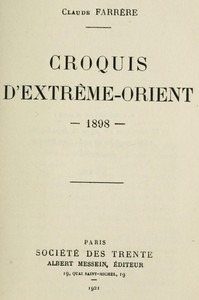
Croquis d'Extrême-Orient, 1898 by Claude Farrère
Claude Farrère’s Croquis d'Extrême-Orient, 1898 is a collection of literary sketches, not a traditional novel. There’s no central hero or continuous plot. Instead, Farrère, serving as a French naval officer, acts as our guide through the ports and cities of East Asia at the turn of the century. We move from Japan to China, to French Indochina (modern-day Vietnam). Each sketch is a self-contained scene—a moment observed from the deck of a ship, a conversation overheard in a tea house, a walk through a crowded market.
The Story
Think of it as a series of vivid postcards. One moment you’re feeling the disciplined silence of a Japanese garden, the next you’re caught in the humid, chaotic energy of Saigon. Farrère doesn’t just describe landscapes; he captures interactions. We see the uneasy dance between European colonizers and local populations, the mix of curiosity and resentment, the cultural misunderstandings that are sometimes comic and often deeply sad. The ‘story’ is the slow realization of a massive power imbalance playing out in everyday encounters. It’s the world of 1898, frozen in a dozen sharp, detailed impressions.
Why You Should Read It
I loved this book for its honesty and its lack of a grand agenda. Farrère isn’t writing a political manifesto; he’s showing us what he saw, and his perspective is fascinatingly conflicted. He’s part of the colonial system, yet he’s often a critical observer of it. You can feel his admiration for the cultures he visits, mixed with the inescapable bias of his time. The writing is beautifully crisp—these are quick strokes that somehow paint a complete picture. Reading it feels less like studying history and more like peering through a window into a specific, vanishing moment. It gives you the texture of the past, the sounds and smells, in a way a history book often can’t.
Final Verdict
This is a perfect book for a thoughtful reader who enjoys travel writing, history from the ground up, or just beautiful, precise prose. If you liked the immersive feel of a book like The Quiet American but want something even more fragmentary and atmospheric, you’ll connect with this. It’s also great for short-burst reading—you can easily enjoy one sketch at a time. Just be ready: it’s not a comforting escape. It’s a quiet, powerful look at a world in transition, leaving you with lingering images and questions that stick around long after you finish the last page.
This publication is available for unrestricted use. Feel free to use it for personal or commercial purposes.
Carol Jones
1 year agoFast paced, good book.
Donna Lopez
1 year agoAfter hearing about this author multiple times, the arguments are well-supported by credible references. Definitely a 5-star read.
Jackson Lee
1 year agoHaving read this twice, the flow of the text seems very fluid. Exceeded all my expectations.